
Bondvoyage
Bondvoyage
Bondvoyage
Bondvoyage
Product Design Project for an AI-Powered Group Travel App.
Product Design Project for an AI-Powered Group Travel App.
Product Design Project for an AI-Powered Group Travel App.

TIMELINE
TIMELINE
January 2025 - April 2025
January 2025 - April 2025
January 2025 - April 2025
TEAM
TEAM
4 Product Designers
4 Product Designers
4 Product Designers
SKILLS
SKILLS
Figma, User Research, Prototyping
Figma, User Research, Prototyping
To create a desirable, viable, and feasible group-travel mobile platform for all age demographics.
OVERVIEW
OVERVIEW
OVERVIEW
I grounded our app with market data and built a business case for it.
I grounded our app with market data and built a business case for it.
I grounded our app with market data and built a business case for it.
BondVoyage was a course project where we designed an AI-Powered Group Travel App, and created a viable plan to bring it to market.
BondVoyage was a course project where we designed an AI-Powered Group Travel App, and created a viable plan to bring it to market.
BondVoyage was a course project where we designed an AI-Powered Group Travel App, and created a viable plan to bring it to market.

Full App Flow
Full App Flow
Full App Flow
MARKET RESEARCH
MARKET RESEARCH
MARKET RESEARCH
I studied the market and uncovered cultural trends that defined our strategy.
I studied the market and uncovered cultural trends that defined our strategy.
I studied the market and uncovered cultural trends that defined our strategy.
Before designing anything, I led the market research to ground our solution around three significant cultural trends.
Before designing anything, I led the market research to ground our solution around three significant cultural trends.
Before designing anything, I led the market research to ground our solution in real-world studies. My analysis revealed three powerful cultural trends that shaped BondVoyage’s initial direction.
Social Media Trip Ideas Don't Get Booked
Why it mattered:
No tool currently bridges the gap between social media discovery and actual trip planning,.
Social Media Trip Ideas Don't Get Booked
Why it mattered:
No tool currently bridges the gap between social media discovery and actual trip planning,.
Inspiration Flood, Organization Drought
Social media is where trips are born, but inspiration gets lost.
Why it mattered:
BondVoyage needed to bridge the gap between social media discovery and actual trip planning.
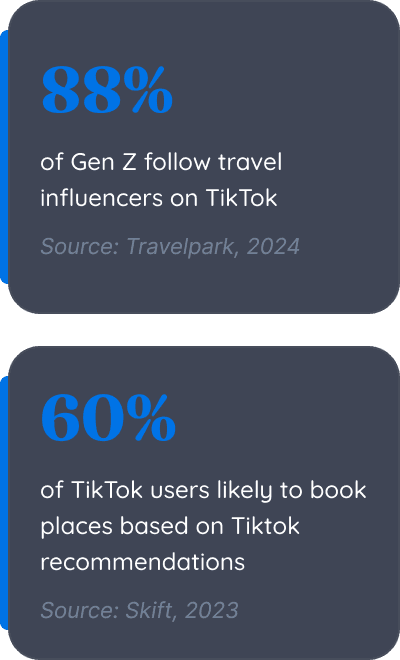
1. Social Media Trip Ideas Don't Get Booked
Why it mattered:
No tool bridged the gap between social media discovery and actual trip planning.
More People are Traveling Together
Why it mattered:
The market still lacks a way to simplify coordination and manage diverse preferences under one trip itinerary.
More People are Traveling Together
Why it mattered:
The market still lacks a way to simplify coordination and manage diverse preferences under one trip itinerary.
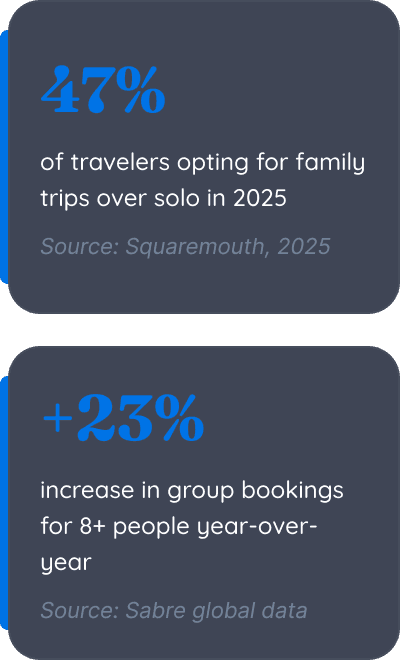
2. Group Travel is Booming, but So is the Stress
More people are traveling together, yet planning across different ages and tastes remains painful.
Why it mattered:
We needed a tool that could handle diverse group dynamics without adding group friction.
2. Group Trip Planning Is on the Rise
Why it mattered:
The market still lacks a way to manage diverse preferences under one trip itinerary.
People Want Flexibility In Their Trip Plans
Why it mattered:
No existing tools offer new site suggestions that dynamically adapt to unexpected circumstances.
People Want Flexibility In Their Trip Plans
Why it mattered:
No existing tools offer new site suggestions that dynamically adapt to unexpected circumstances.
3. Experience Expectations Have Evolved
Today’s travelers, especially groups, crave hyper-personalized, local, and flexible experiences.
Why it mattered:
BondVoyage had to offer dynamic recommendations that could pivot for last-minute circumstances.
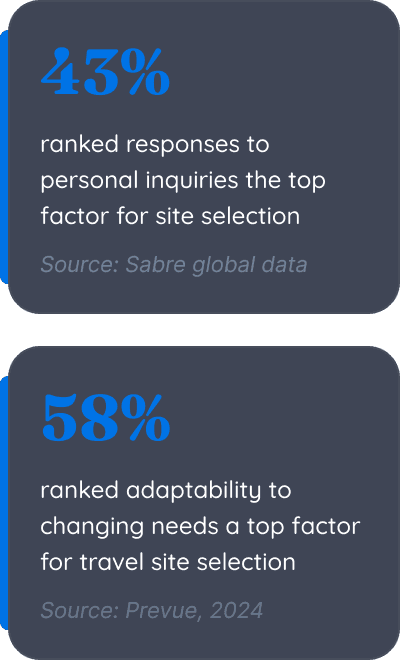
3. People Want Flexibility In Trip Plans
Why it mattered:
No existing tools offer new site suggestions for unexpected circumstances.
PROBLEM DEFINITION
PROBLEM DEFINITION
PROBLEM DEFINITION
I created a problem statement and an MVP that primarily addressed diverse group preferences.
I created a problem statement and an MVP that primarily addressed diverse group preferences.
I created a problem statement and an MVP that addressed diverse group preferences.
After conducing market research, I then helped formulate our problem statement:
"Planning a group trip is tricky—everyone has different tastes, and things like weather or changing moods can throw off even the best itinerary."
From there, I developed a Value Proposition Canvas, connecting user needs with how our MVP would deliver it.
After conducing market research, I then helped formulate our problem statement:
"Planning a group trip is tricky—everyone has different tastes, and things like weather or changing moods can throw off even the best itinerary."
From there, I developed a Value Proposition Canvas, connecting user needs with how our MVP would deliver it.
After conducing market research, I took these quantitative metrics and helped formulate our problem statement:
"Planning a group trip is tricky—everyone has different tastes, and things like weather or changing moods can throw off even the best itinerary."
From there, I developed a Value Proposition Canvas, connecting user needs with how BondVoyage would deliver it.
User Needs:
Planning for various people’s preferences in group trips.
Plans that have flexibility for unforeseen circumstances like bad weather.
Plans that account for different energy levels, budgets, and taste changes throughout the trip.
Initial MVP:
A preemptive quiz to identify each traveler’s needs before the trip starts.
A dynamic itinerary that changes as needed, offering replacement suggestions informed by everyone's input.
Having a split-up feature that to let sub-groups within the trip pursue different activities when preferences diverged.
After conducing market research, I took these quantitative metrics and helped formulate our problem statement:
"Planning a group trip is tricky—everyone has different tastes, and things like weather or changing moods can throw off even the best itinerary."
From there, I developed a Value Proposition Canvas, connecting what users truly needed with how BondVoyage would deliver it.
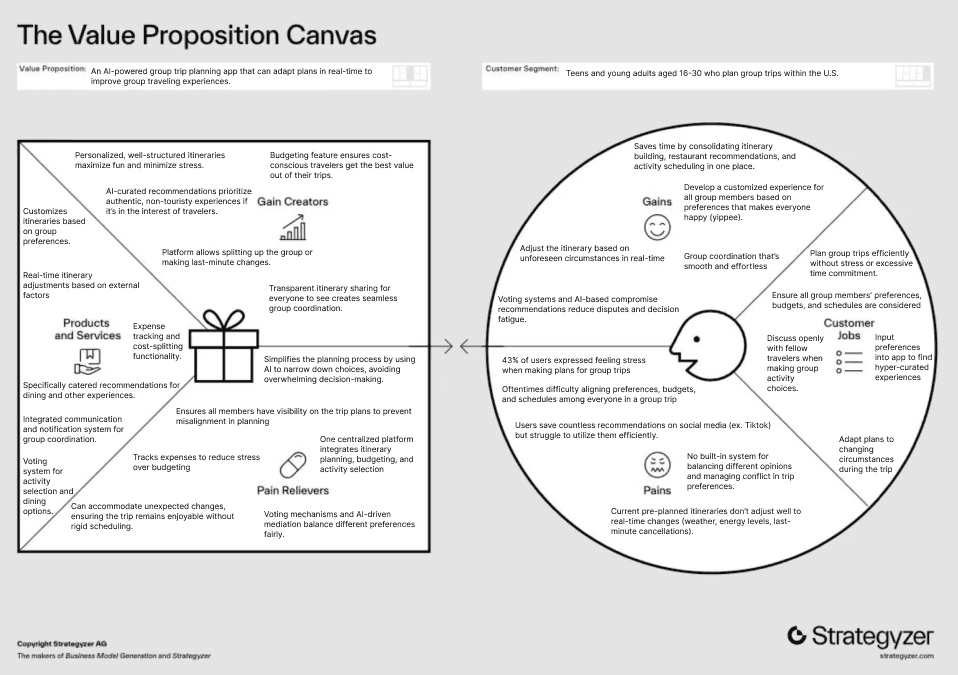
Value Proposition Canvas
Value Proposition Canvas
User Needs:
Planning for various people’s preferences in group trips.
Plans that have flexibility for unforeseen circumstances.
Plans that account for different energy levels, budgets, and interests throughout the trip.
User Needs:
Planning for various people’s preferences in group trips.
Plans that have flexibility for unforeseen circumstances.
Plans that account for different energy levels, budgets, and interests throughout the trip.
After conducing market research, I took these quantitative metrics and helped formulate our problem statement:
"Planning a group trip is tricky—everyone has different tastes, and things like weather or changing moods can throw off even the best itinerary."
From there, I developed a Value Proposition Canvas, connecting user needs with how BondVoyage would deliver it.
User Needs:
Planning for various people’s preferences in group trips.
Plans that have flexibility for unforeseen circumstances like bad weather.
Plans that account for different energy levels, budgets, and taste changes throughout the trip.
Initial MVP:
A preemptive quiz to identify each traveler’s needs before the trip starts.
A dynamic itinerary that changes as needed, offering replacement suggestions informed by everyone's input.
Having a split-up feature that to let sub-groups within the trip pursue different activities when preferences diverged.
User Needs:
Planning for various people’s preferences in group trips.
Plans that have flexibility for unforeseen circumstances like bad weather.
Plans that account for different energy levels, budgets, and taste changes throughout the trip.
Initial MVP:
A preemptive quiz to identify each traveler’s needs.
A dynamic trip planner that can offer replacement suggestions informed by everyone's input.
Having a split-up feature that lets the group split up to do different activities when preferences diverged.
Initial MVP:
A preemptive quiz to identify each traveler’s needs.
A dynamic trip planner that can offer replacement suggestions informed by everyone's input.
Having a split-up feature that lets the group split up to do different activities when preferences diverged.
After conducing market research, I took these quantitative metrics and helped formulate our problem statement:
"Planning a group trip is tricky—everyone has different tastes, and things like weather or changing moods can throw off even the best itinerary."
From there, I developed a Value Proposition Canvas, connecting user needs with how BondVoyage would deliver it.
User Needs:
Planning for various people’s preferences in group trips.
Plans that have flexibility for unforeseen circumstances like bad weather.
Plans that account for different energy levels, budgets, and taste changes throughout the trip.
Initial MVP:
A preemptive quiz to identify each traveler’s needs before the trip starts.
A dynamic itinerary that changes as needed, offering replacement suggestions informed by everyone's input.
Having a split-up feature that to let sub-groups within the trip pursue different activities when preferences diverged.
Initial MVP:
A preemptive quiz to identify each traveler’s needs before the trip starts.
A dynamic itinerary that changes as needed, offering replacement suggestions informed by everyone's input.
Having a split-up feature that to let sub-groups within the trip pursue different activities when preferences diverged.
DESIGN BLUEPRINT
DESIGN BLUEPRINT
DESIGN BLUEPRINT
We created a user flow and low-fidelity wireframes to transform assumptions into testable blueprints.
We created a user flow and low-fidelity wireframes to transform assumptions into testable blueprints.
We created a user flow and low-fidelity wireframes to transform assumptions into testable blueprints.
User Flow
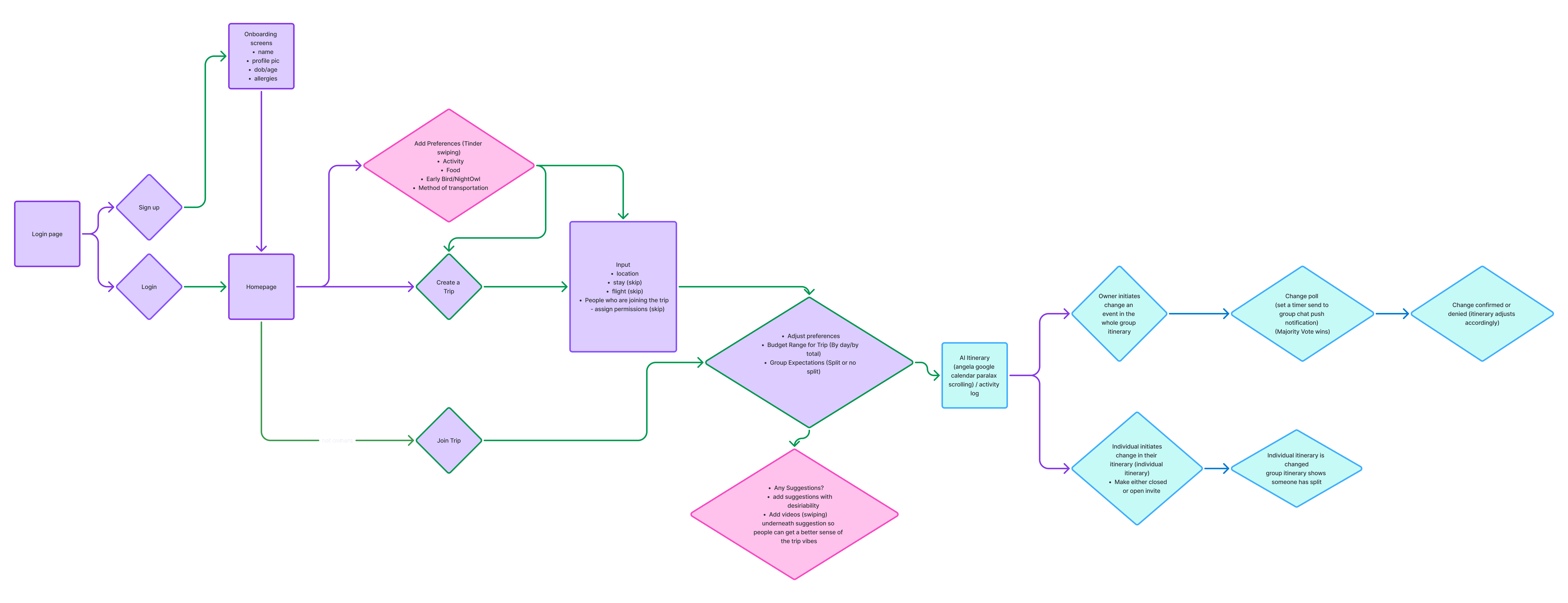
Our user flow diagram mapped the full end-to-end journey: onboarding, Tinder-style preference swiping, trip creation, AI-generated itinerary, and the Plan B re-planning. Laying out every path before visual design helped us spot where our hypotheses would be tested.
User Flow
Our user flow diagram mapped the full end-to-end journey: onboarding, Tinder-style preference swiping, trip creation, AI-generated itinerary, and the Plan B re-planning. Laying out every path before visual design helped us spot where our hypotheses would be tested.
User Flow
Our user flow diagram mapped the full end-to-end journey: onboarding, Tinder-style preference swiping, trip creation, AI-generated itinerary, and the Plan B re-planning. Laying out every path before visual design helped us spot where our hypotheses would be tested.
Wireframes
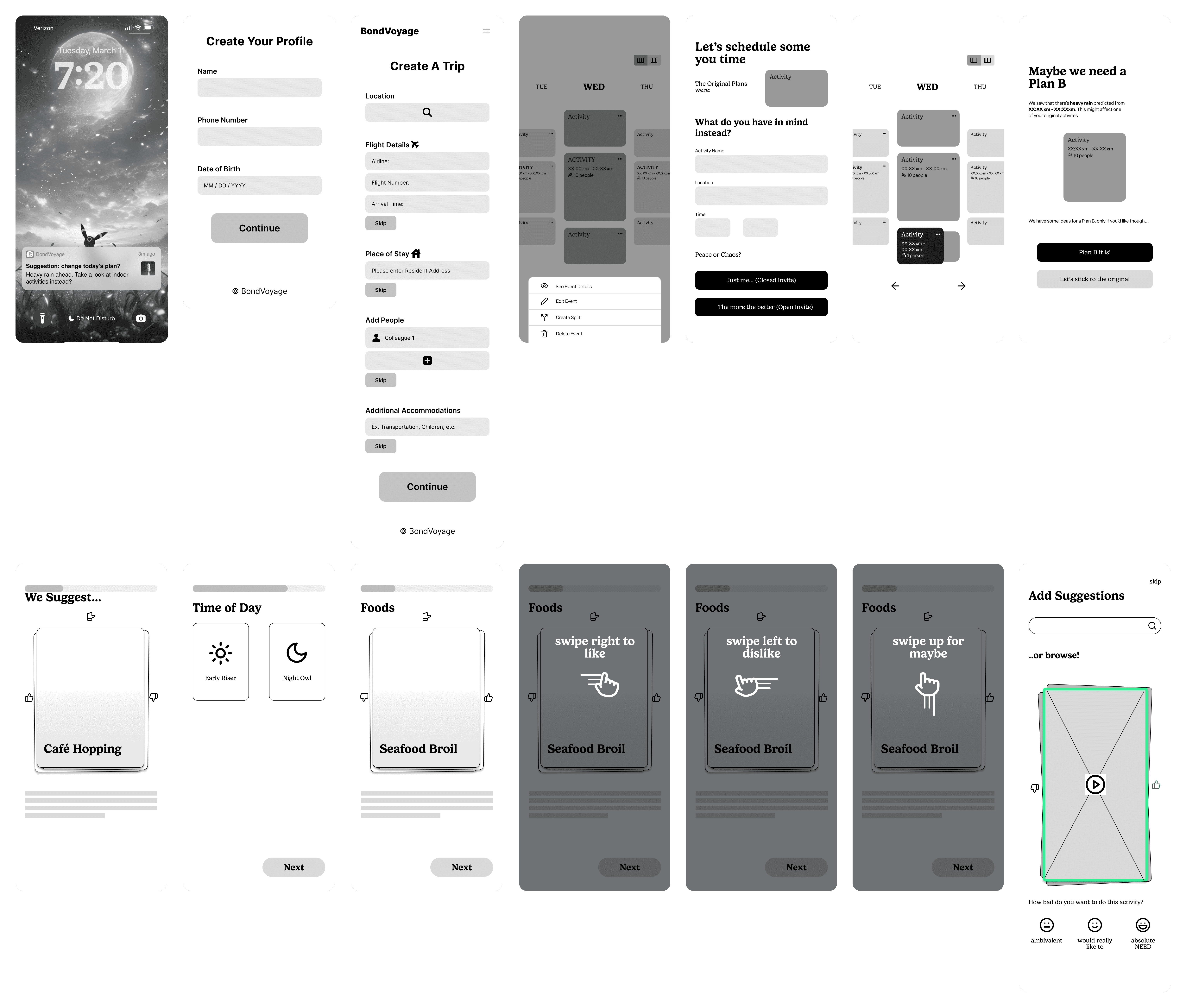
The low-fidelity screens translated our user flow into bare-bones layouts: preference swiping cards, the itinerary calendar with activity cards, the “Create Split” option for individual detours, and the Plan B notification.
Wireframes
The low-fidelity screens translated our user flow into bare-bones layouts: preference swiping cards, the itinerary calendar with activity cards, the “Create Split” option for individual detours, and the Plan B notification.
Wireframes
The low-fidelity screens translated our user flow into bare-bones layouts: preference swiping cards, the itinerary calendar with activity cards, the “Create Split” option for individual detours, and the Plan B notification.
USABILITY TESTING
USABILITY TESTING
USABILITY TESTING
77% of users prioritize togetherness on a group trip, prompting a vision pivot.
77% of users prioritize togetherness on a group trip, prompting a vision pivot.
77% of users prioritize togetherness on a group trip, prompting a vision pivot.
One of my most critical research contributions was testing our riskiest assumption through usability testing:
We assumed users wanted a feature to “split up” the group, but 77% of target users disagreed.
Although all other features were validated,
the insight shifted our vision from designing for individual needs to prioritizing group togetherness.
One of my most critical research contributions was testing our riskiest assumption through usability testing:
We assumed users wanted a feature to “split up” the group, but 77% of target users disagreed.
Although all other features were validated,
the insight shifted our vision from designing for individual needs to prioritizing group togetherness.
One of my most critical research contributions was testing our riskiest assumption through usability testing:
We assumed users wanted a feature to “split up” the group, but 77% of target users disagreed.
Although all other features were validated,
the insight shifted our vision from designing for individual needs to prioritizing group togetherness.


Early Split Feature Iterations
Early Split Feature Iterations
Early Split Feature Iterations
VISUAL LANGUAGE
VISUAL LANGUAGE
VISUAL LANGUAGE
We defined a design system that made travel planning feel playful and trustworthy.
We defined a design system that made travel planning feel playful and trustworthy.
We defined a design system that made travel planning feel playful and trustworthy.
Font
Gelica: Our playful display font which signaled that group planning doesn’t have to be stressful.
Elza Round Variable: body text that supports a casual, friendly tone throughout the interface.
Color Palette
Voyage Blue as the primary color injects confidence and action without feeling cold
Neutral-and-light-gray palette for travel photos and preference tags.
Font
Gelica: Our playful display font which signaled that group planning doesn’t have to be stressful.
Elza Round Variable: body text that supports a casual, friendly tone throughout the interface.
Color Palette
Voyage Blue as the primary color injects confidence and action without feeling cold
Neutral-and-light-gray palette for travel photos and preference tags.
Font
Gelica: Our playful display font which signaled that group planning doesn’t have to be stressful.
Elza Round Variable: body text that supports a casual, friendly tone throughout the interface.
Color Palette
Voyage Blue as the primary color injects confidence and action without feeling cold
Neutral-and-light-gray palette for travel photos and preference tags.


Impact:
Every element reinforces a casual tone of voice, which was the vibe we were going for
Tappable pill-shaped tags made preference input feel like a game
Even when our platform suggests last-minute Plan B changes, the interface feels calm and reassuring.
Impact:
Every element reinforces a casual tone of voice, which was the vibe we were going for
Tappable pill-shaped tags made preference input feel like a game
Even when our platform suggests last-minute Plan B changes, the interface feels calm and reassuring.
Every element reinforces the vibe we wanted: a casual tone of voice
Tappable pill-shaped tags that make preference input feel like a game
The system balances playfulness with clarity
Even when the AI suggests last-minute Plan B changes, the interface feels calm and reassuring.
FINAL DESIGNS
FINAL DESIGNS
FINAL DESIGNS
I helped design three core features to deliver an all-in-one travel companion.
I helped design three core features to deliver an all-in-one travel companion.
I helped design three core features to deliver an all-in-one travel companion.
Impact:
Strengthened our all-in-one value proposition, directly tackling the tool fragmentation users complained about.
Discovery & Itinerary Creation
This feature connected social media and trip planning. The structure matched typical social media layouts, while filtering based on location reduced cognitive load.
I helped build a saved-locations library where bookmarked spots fed directly into trip planning
Impact:
Strengthened our all-in-one value proposition, directly tackling the tool fragmentation users complained about.
Discovery & Itinerary Creation
This feature connected social media and trip planning. The structure matched typical social media layouts, while filtering based on location reduced cognitive load.
I helped build a saved-locations library where bookmarked spots fed directly into trip planning
Impact:
Strengthened our all-in-one value proposition, directly tackling the tool fragmentation users complained about.
Discovery & Itinerary Creation
This feature was the bridge connecting social media and trip planning. The visual-first, image-heavy cards matched typical social media layout, while filtering based on location reduced cognitive memory load.
I helped build a saved-locations library where bookmarked spots from the inspiration phase feed directly into the trip planner.
Impact:
These inputs directly trained the AI compromise engine, which 70% of tested users later preferred over competitors’ manual voting.
Preference Input System
We used vibrant, tappable tags as a playful way to capture individual preferences before a trip begins. We pivoted away from swiping cards because there were too many categories to swipe through.
I helped decide the categories that covered food preferences, time-of-day energy (Ex. Early Riser/Night Owl), and other interests.
Impact:
These inputs directly trained the AI compromise engine, which 70% of tested users later preferred over manual voting.
Preference Input System
We used vibrant, tappable tags as a playful way to capture individual preferences before a trip begins. We pivoted away from swiping cards because there were too many categories to swipe through.
I helped decide the categories that covered food preferences, time-of-day energy (Ex. Early Riser/Night Owl), and other interests.
Impact:
These inputs directly trained the AI compromise engine, which 70% of tested users later preferred over manual voting.
Preference Input System
The product required a playful but thorough way to capture individual tastes, diets, and energy levels before a trip begins. The visual tappable tags made complex preference input feel light.
I helped decide the tag-based categories covering food preferences, time-of-day energy (Ex. Early Riser/Night Owl), and other interests.
Impact:
Users no longer had to scramble when plans go awry, because this feature was the practical implementation of our adaptability promises.
Proactive Replanning
A key differentiator of BondVoyage was real-time adaptability, so this feature only suggested relevant alternatives.
I proposed the curated “Plan B” options drawn from the group’s saved preferences, and suggested it appear as notifications on a user's phone.
Impact:
Users no longer had to scramble when plans go awry, because this feature was the implementation of our adaptability promises.
Proactive Replanning
A key differentiator of BondVoyage was real-time adaptability, so this feature only suggested relevant alternatives.
I proposed the curated “Plan B” options drawn from the group’s saved preferences, and suggested it appear as notifications on a user's phone.
Impact:
Users no longer had to scramble when plans go awry, because this feature was the implementation of our adaptability promises.
Proactive Replanning
A key differentiator of BondVoyage was real-time adaptability, so this feature had contexual awareness, meaning it only suggested relevant alternatives (And wouldn't suggest things like outdoor dinner in the rain).
I designed an AI-driven notification that could detect weather conflicts and propose curated “Plan B” options drawn from the group’s saved preferences.
COMPETITIVE ANALYSIS
COMPETITIVE ANALYSIS
COMPETITIVE ANALYSIS
My competitive audit of existing platforms validated our unique customer value.
My competitive audit of existing platforms validated our unique customer value.
My competitive audit of existing platforms validated our unique customer value.
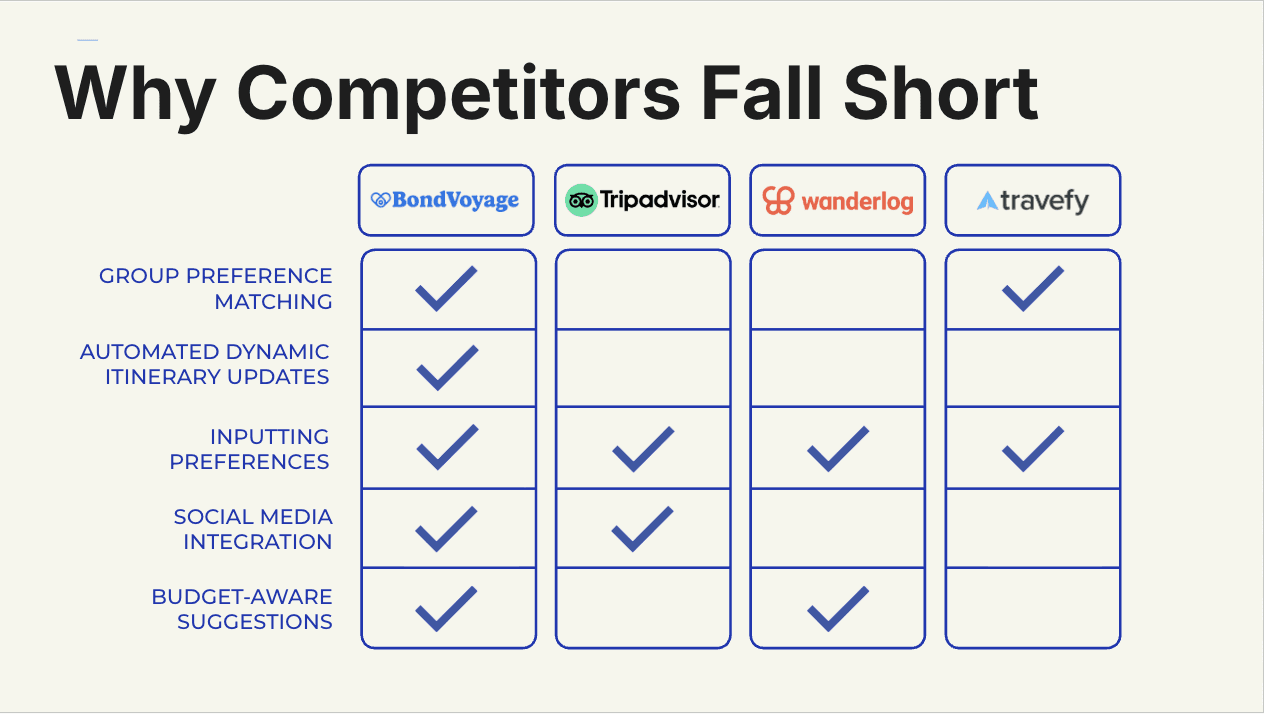
Because we had to consider how our product would fare in the market, I conducted a competitor analysis with TripAdvisor, Wanderlog, and Travefy.
Because we had to consider how our product would fare in the market, I conducted a competitor analysis with TripAdvisor, Wanderlog, and Travefy.
Because we had to consider how our product would fare in the market, I conducted a competitor analysis with TripAdvisor, Wanderlog, and Travefy.
Findings:
After evaluating our competitors across 5 categories suited for Bondvoyage, we found that no competitor offered more than 2.
Most competitors focused on solo planning and ignored real-time adaptation and group-compromise generation.
Findings:
After evaluating our competitors across 5 categories suited for Bondvoyage, we found that no competitor offered more than 2.
Most competitors focused on solo planning and ignored real-time adaptation and group-compromise generation.
Findings:
After evaluating our competitors across 5 categories suited for Bondvoyage, we found that no competitor offered more than 2.
Most competitors focused on solo planning and ignored real-time adaptation and group-compromise generation.
MARKET SIZING
MARKET SIZING
MARKET SIZING
I defined our TAM, SAM, and SOM to evaluate monetary opportunities.
I defined our TAM, SAM, and SOM to evaluate monetary opportunities.
I defined our TAM, SAM, and SOM to evaluate monetary opportunities.
Impact: This market sizing grounded our entire pitch in data, showing the opportunity was both a cool idea and a financially sound one.
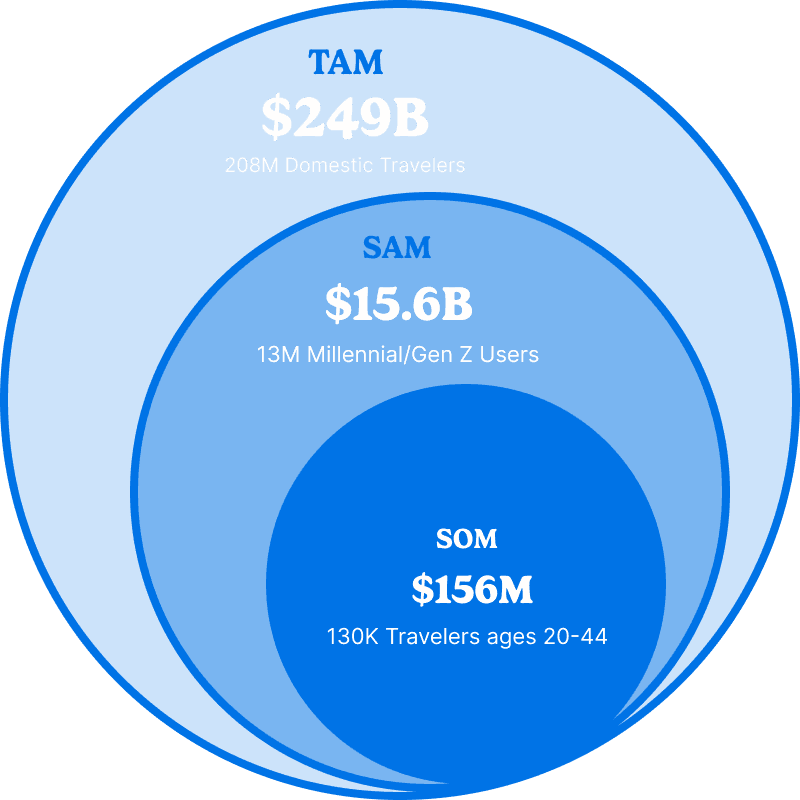
Total Addressable Market:
$249B U.S. domestic travel market (208M travelers who each spend ~$1200 on average).
Service Addressable Market:
Using industry data showing 43% of 30M Gen Z/Millenials who report decision fatigue, we identified ~13M potential users.
Service Obtainable Market:
Targeting 1% of the SAM segment = 130,000 users.
Impact: This market sizing grounded our entire pitch in data, showing the opportunity was both a cool idea and a financially sound one.
Total Addressable Market:
$249B U.S. domestic travel market (208M travelers who each spend ~$1200 on average).
Service Addressable Market:
Using industry data showing 43% of 30M Gen Z/Millenials who report decision fatigue, we identified ~13M potential users.
Service Obtainable Market:
Targeting 1% of the SAM segment = 130,000 users.
Because product design entails thinking about how a product will fare in the market after designing it, I defined the market size to evaluate monetary opportunities and build marketing strategies..
Total Addressable Market: $249B U.S. domestic travel market (208M travelers).
Service Addressable Market: Using industry data showing 43% of 30M report decision fatigue, we identified ~13 million potential users.
Service Obtainable Market: Targeting 10% of the SAM segment = 650,000 users.
Impact:
This market sizing grounded our entire pitch in data, showing the opportunity wasn’t just a cool idea but a financially sound one.
Total Addressable Market:
$249B U.S. domestic travel market (208M travelers who each spend ~$1200 on average).
Service Addressable Market:
Using industry data showing 43% of 30M Gen Z/Millenials who report decision fatigue, we identified ~13M potential users.
Service Obtainable Market:
Targeting 1% of the SAM segment = 130,000 users.
PRODUCT ROADMAP
PRODUCT ROADMAP
PRODUCT ROADMAP
I charted a 5-year roadmap to balance monetization with user growth.
I charted a 5-year roadmap to balance monetization with user growth.
To capture the market we sized and build on the go-to-market strategy, I outlined a 5-year roadmap that balances early revenue generation, product expansion, and global scaling.
To capture the market we sized and build on the go-to-market strategy, I outlined a 5-year roadmap that balances early revenue generation, product expansion, and global scaling.
To capture the market we sized and build on the go-to-market strategy, I outlined a 5-year roadmap that balances early revenue generation, product expansion, and global scaling.
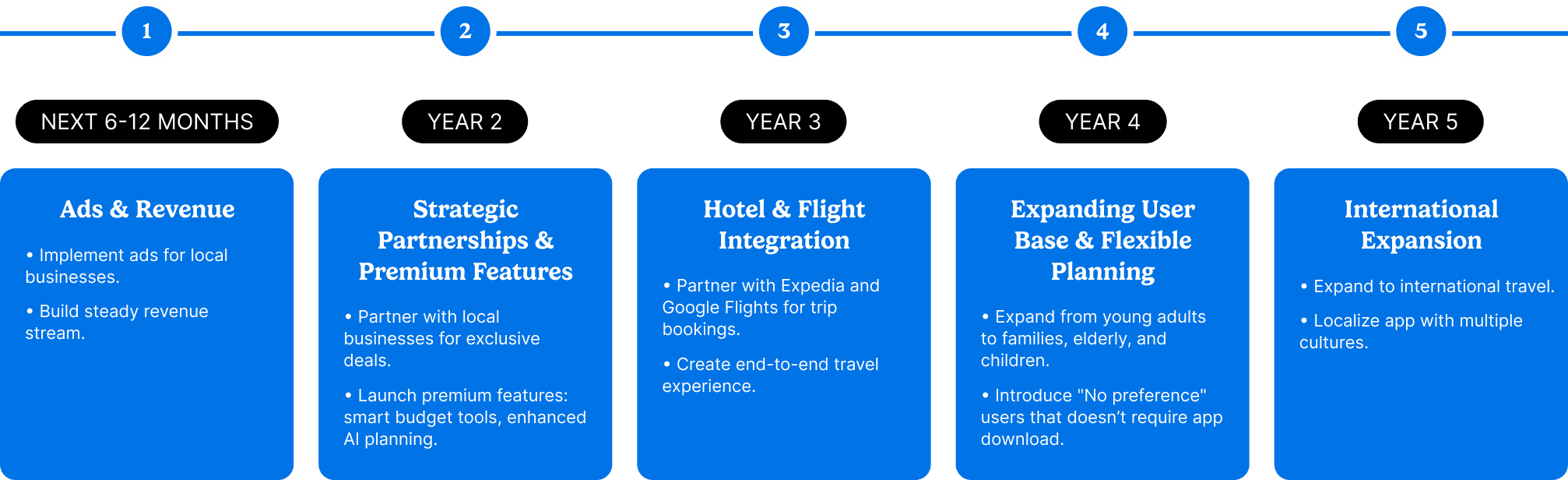
Next 6–12 Months: Ads & Revenue Foundation
Introduce non-intrusive ads for local businesses, creating a revenue stream to reinvest in feature development.
Year 2: Strategic Partnerships & Premium Features
Partner with travel businesses for exclusive in-app deals
Launch premium features (smart budget tools, AI learning).
Year 3: Hotel & Flight Integration
Partner with Expedia, Google Flights, and other major platforms to let groups book hotels and flights within BondVoyage.
Year 4: Expanding User Base & Flexible Planning
Expand target demographic to families and multi-generational groups.
Trip members who don’t want to download the app can still receive trip updates and changes via web or SMS.
Year 5+: International Expansion
Extend beyond our initial U.S. city focus to international travel.
The app will be localized with multiple languages and currencies.
Next 6–12 Months: Ads & Revenue Foundation
Introduce non-intrusive ads for local businesses, creating a revenue stream to reinvest in feature development.
Year 2: Strategic Partnerships & Premium Features
Partner with travel businesses for exclusive in-app deals
Launch premium features (smart budget tools, AI learning).
Year 3: Hotel & Flight Integration
Partner with Expedia, Google Flights, and other major platforms to let groups book hotels and flights within BondVoyage.
Year 4: Expanding User Base & Flexible Planning
Expand target demographic to families and multi-generational groups.
Trip members who don’t want to download the app can still receive trip updates and changes via web or SMS.
Year 5+: International Expansion
Extend beyond our initial U.S. city focus to international travel.
The app will be localized with multiple languages and currencies.
Next 6–12 Months: Ads & Revenue Foundation
Introduce non-intrusive ads for local businesses, creating a revenue stream to reinvest in feature development.
Year 2: Strategic Partnerships & Premium Features
Partner with travel businesses for exclusive in-app deals
Launch premium features (smart budget tools, AI learning).
Year 3: Hotel & Flight Integration
Partner with Expedia, Google Flights, and other major platforms to let groups book hotels and flights within BondVoyage.
Year 4: Expanding User Base & Flexible Planning
Expand target demographic to families and multi-generational groups.
Trip members who don’t want to download the app can still receive trip updates and changes via web or SMS.
Year 5+: International Expansion
Extend beyond our initial U.S. city focus to international travel.
The app will be localized with multiple languages and currencies.
VALIDATION METRICS
VALIDATION METRICS
VALIDATION METRICS
70% user preference over competitors, 65% faster planning, and 70% willingness to pay for the product.
70% user preference over competitors, 65% faster planning, and 70% willingness to pay for the product.
70% user preference over competitors, 65% faster planning, and 70% willingness to pay for the product.
Our final deliverable was a complete product narrative. This included a marketing plan and a high-fidelity Figma prototype.
Our final deliverable was a complete product narrative. This included a marketing plan and a high-fidelity Figma prototype.
Our final deliverable was a complete product narrative. This included a marketing plan and a high-fidelity Figma prototype.
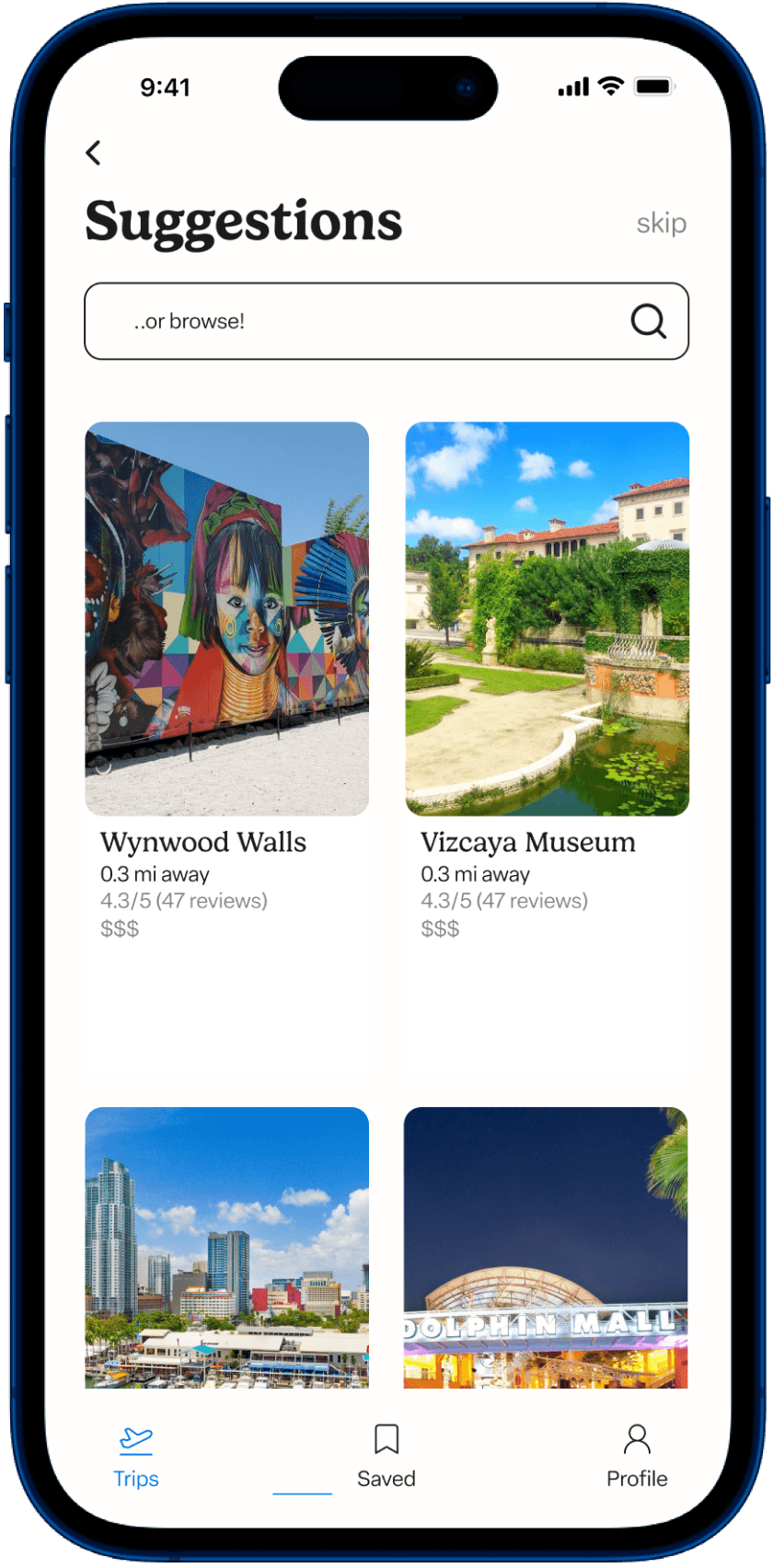

Success metrics from user testing were strong: a 70% preference over competitors, a 65% reduction in planning time, and a 70% willingness to pay for premium features.
*As a course project, our work encompassed everything leading up to but not including technical implementation.*
Success metrics from user testing were strong: a 70% preference over competitors, a 65% reduction in planning time, and a 70% willingness to pay for premium features.
*As a course project, our work encompassed everything leading up to but not including technical implementation.*
Success metrics from user testing were strong: a 70% preference over competitors, a 65% reduction in planning time, and a 70% willingness to pay for premium features.
*As a course project, our work encompassed everything leading up to but not including technical implementation.*
LEARNINGS & IMPACT
LEARNINGS & IMPACT
LEARNINGS & IMPACT
Combining research, design, and strategy builds a product people will pay & advocate for.
Combining research, design, and strategy builds a product people will pay & advocate for.
Combining research, design, and strategy builds a product people will pay & advocate for.
User Opinions Reveal Real Needs
When 77% of surveyed users rejected the "split-up" idea, it forced a pivotal shift towards preserving group cohesion.
Data Synthesis and Market Research Is Key
43% decision fatigue rate among group travelers
47% of event planners who rank itinerary adaptability above destination popularity.
Strategy and Design Are Inseparable
A design system and thoughtful information architecture mean little without rigorous business modeling.
Ultimately, I learned that when research, design, and market strategy move together, I can build a product that is both human-centered and business-ready.
User Opinions Reveal Real Needs
When 77% of surveyed users rejected the "split-up" idea, it forced a pivotal shift towards preserving group cohesion.
Data Synthesis and Market Research Is Key
43% decision fatigue rate among group travelers
47% of event planners who rank itinerary adaptability above destination popularity.
Strategy and Design Are Inseparable
A design system and thoughtful information architecture mean little without rigorous business modeling.
Ultimately, I learned that when research, design, and market strategy move together, I can build a product that is both human-centered and business-ready.
User Opinions Reveal Real Needs
When 77% of surveyed users rejected the "split-up" idea, it forced a pivotal shift towards preserving group cohesion.
Data Synthesis and Market Research Is Key
43% decision fatigue rate among group travelers
47% of event planners who rank itinerary adaptability above destination popularity.
Strategy and Design Are Inseparable
A design system and thoughtful information architecture mean little without rigorous business modeling.
Ultimately, I learned that when research, design, and market strategy move together, I can build a product that is both human-centered and business-ready.


Thanks For Stopping By
© David Jin 2026